FLORIDA NEWSWIRE (ST. PETERSBURG, Fla.) — While modern pediatric leukemia treatment stands as one of oncology’s greatest triumph stories, a quiet and urgent crisis persists for adolescent and young adult (AYA) patients diagnosed with high-risk acute blood cancers. St. Petersburg-based Jackson Copeland Foundation targets the massive survival disparity gap in AYA acute myeloid leukemia, raising funds for pioneering research with Oct. 30 Anchors & Irons Invitational charity golf tournament in Clearwater.
Over the past two decades, five-year survival rates for childhood acute lymphoblastic leukemia (ALL) have climbed to over 90%. By contrast, young adults diagnosed with high-risk acute myeloid leukemia (AML) face a vastly different reality. Even at initial diagnosis, frontline intensive therapy yields a five-year survival rate of only ~50%-lagging 40 percentage points behind pediatric ALL. For those who experience a relapse, five-year survival rates plummet to a dismal 10%.
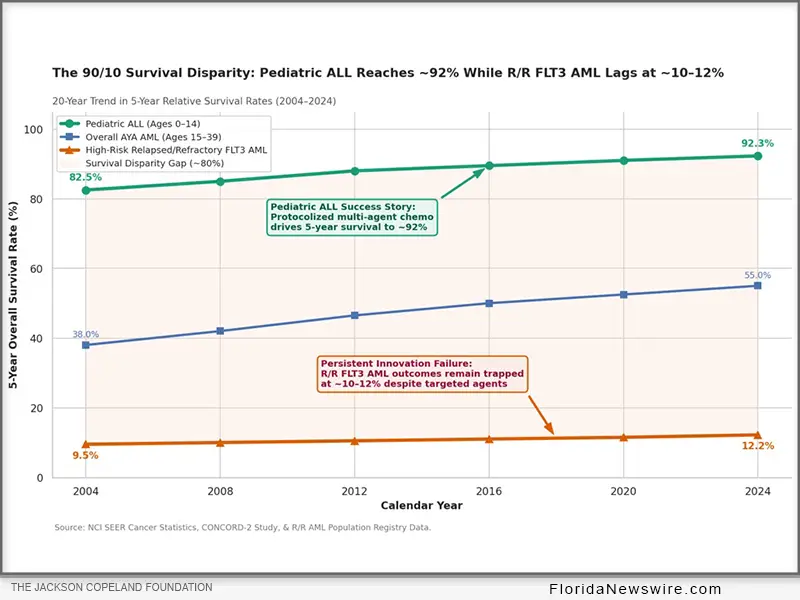
This profound outcome gap poses a vital question for the medical community: Does the persistent stagnation of survival in high-risk young adult leukemia reflect a fundamental flaw in medical research and funding priorities?
Headquartered in St. Petersburg, FL, The Jackson Copeland Foundation was established in 2025 specifically to spotlight this survival gap and funnel vital resources directly into cutting-edge research. In 2026, the Foundation established a new research seed fund with the Center for Advanced Leukemia Therapies and Research in Ohio, directly supporting AML researcher Dr. Courtney Jones. Dr. Jones’s lab focuses on uncovering novel metabolic dependencies and therapeutic targets in high-risk acute myeloid leukemia to overcome drug resistance and disease recurrence.
The Jackson Copeland Foundation is currently just $11,500 short of completing its 2026 research funding commitment to Dr. Jones’s lab, making upcoming fourth quarter community fundraising efforts crucial to maintaining momentum.
In addition to funding laboratory research, The Jackson Copeland Foundation delivers direct, hands-on assistance to leukemia patients and their families year-to-date in 2026:
* 100+ Families Assisted: Provided direct financial assistance grants to over 100 leukemia patients and their families to offset living expenses and travel costs during lengthy hospitalizations.
* 40+ Stem Cell Registry Additions: Added more than 40 new potential bone marrow and stem cell donors to the DKMS and National Marrow Donor Program (NMDP) registries through community swab drives.
* 40+ Blood Units Collected: Directly contributed over 40 units of life-saving blood products to OneBlood through sponsored community donation events.
To bridge the remaining $11,500 research gap and continue direct patient grants, The Jackson Copeland Foundation is hosting its inaugural charity golf tournament event in partnership with VETSports Florida:
* Event Title: The Anchors & Irons Invitational & After-Action Social
* Date: Friday, October 30th, 2026
* Location: Cove Cay Golf Club – Clearwater, FL
* Community Invitation: Local golfers, business sponsors, community volunteers, and donors are invited to join for a day of golf and networking to learn more about AYA leukemia, register for the stem cell donor registry on-site, and support the Foundation’s research mission.
Established in 2025 and headquartered in St. Petersburg, FL, The Jackson Copeland Foundation is a 501(c)(3) non-profit organization dedicated to spotlighting and closing the survival disparity gap for adolescent and young adult (AYA) patients diagnosed with high-risk acute myeloid leukemia (AML). Through targeted research seed funding-including its 2026 grant to the Center for Advanced Leukemia Therapies and Research-direct patient financial assistance, and stem cell registry drives, the Foundation empowers families and advances life-saving clinical breakthroughs.
To register for the Oct. 30 Anchors & Irons Invitational or contribute to their research or patient support programs, visit https://jacksoncopeland.org/
To ensure complete scientific rigor and verifiability, the underlying clinical and epidemiological data points are sourced from established national registries and peer-reviewed clinical trial literature:
* Pediatric ALL (Ages 0-19) [~92% 5-Year Survival]: Verified via the National Cancer Institute (NCI) Surveillance, Epidemiology, and End Results (SEER) program and CONCORD-2 population-based net survival registry data, demonstrating pediatric ALL survival rising from ~50% in earlier decades to >90% today.
* Newly Diagnosed AYA FLT3-AML [~50% 5-Year Survival]: Verified via Phase III trial follow-up data (e.g., RATIFY/CALGB 10603) evaluating adult patients (ages 18-60) receiving frontline intensive chemotherapy plus targeted FLT3 inhibitors (midostaurin), achieving 4-to-5-year overall survival of 51.4% versus 44.3% with chemotherapy alone. Despite targeted advances, outcomes at initial diagnosis still lag drastically behind pediatric benchmarks (~50% vs. ~90%).
* Relapsed/Refractory FLT3-AML [~10-12% 5-Year Survival]: Verified via real-world population registry studies (Alberta Cancer Registry, 2020) and pivotal salvage trial cohorts (ADMIRAL trial), demonstrating a median overall survival of 5.3 to 10.6 months and 5-year survival of ~10-12% for relapsed/refractory AML patients unable to receive a successful stem cell transplant bridge.
VIDEO (YouTube):
* * *
This version of news story was first published on and is Copr. © 2026 Florida Newswire (FloridaNewswire.com) – all rights reserved.